Whoever has the gold, makes the rules.
- Jafar from Disney's Aladdin
Regardless of the movie genre, you can always find some truth in movie dialog - even in a Disney movie. While today's quote is the perfect segue into why there has been a lack of financial fraud prosecutions since the beginning of the debt crisis, this blog attempts to steer clear of political discussions.
 |
| Source: Transactional Records Clearinghouse at Syracuse University |
Thus while the above chart sickens me, it is not today's topic. So then why the Disney quote you might ask? Gold.
Even if this blog goes viral, I'll never have the amount of gold required to make the rules. However I can still use gold investments to retain wealth. Why? Because regardless of what you read, gold is a store of value, which is one way of saying gold is money. Think about this, if someone offered you a certified gold bar for your house, would you turn them away or check how many dollars you would receive upon cashing it in?
Gold Another Diversification Option for Your Portfolio
Most people think of gold as protection against inflation. Overall I think this is true, but only relative to the investment time. Just like all investment classes go in and out of favor, I believe the same is true for gold.
For example in the 1970s, prices were rising for everything thanks to government spending programs, Vietnam, and the oil embargo. Note below in the Consumer Price Index, prices roughly doubled from 1970 to 1980.

Labor costs, which reflect wages, also double during this time period.

Also President Nixon closed the gold window, which meant the U.S. government would no longer convert dollars to gold. The price of gold would freely float against the dollar. Accordingly as prices for everything continued to increase, so did the price of gold.
 |
| Source: Kitco.com |
Add the Iran Hostage crisis with the appearance that inflation was never going to end, you have a situation where investors will seek safety for their wealth. Gold prices went vertical.
The Gold Investment Fad Ends
Moving on to the 1980s and 1990s, Paul Volcker's Federal Reserve turned inflation to disinflation (meaning the rate of prices going up was decreasing) by means of high interest rates. New bonds issued by the U.S. Treasury attracted attention as high rates could be locked in for up to 30 years. Additionally if interest rates fell, these bond prices would rise, so you earn a gain on the price you paid if you sold.
Stocks were attractive too as their prices relative to earnings were low. As interest rates fell, companies and consumers could borrow more to buy more. This led to growing sales and a growing economy, which brought higher stock prices. New industries were created - computers, software, internet, which led to more growth.
All of this stability and growth made gold unattractive versus these other opportunities even though there was inflation in the economy. One traditional safe investment, the ten year bond, was paying over 10 percent in the early 1980s. The thirty year bond could be bought for close to the same rates too!

Compared to a dividend paying stock or a bond, gold doesn't earn a return. Hence gold prices fell from their high as better returns were to be made elsewhere.
 |
| Source: Kitco.com |
Droughts Seldom Last Forever
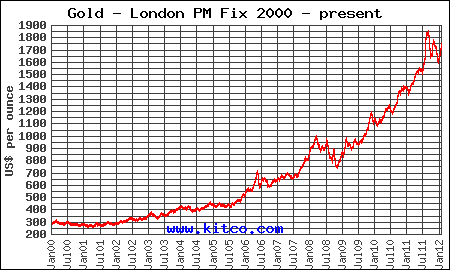
Fast forward to 2000, stock markets are spiking to all time highs. However earnings for many companies are questionable. Price-to-earning ratios are astronomical even for companies that earned money. Bonds earned a decent return around 6%.
Now if you were invested in stocks, where do you store hard earned gains if it appears everything is going to fall? Remember in a stock rout, everything gets sold even good companies. The reason behind this phenomenon is leveraged investors (e.g. investors who borrowed money to buy stocks). As the amount of collateral in their account retreats, these investors get a margin call. At that moment they either need to add more cash/collateral, or sell what they can to meet the requirements. Hence good companies get sold because the bad companies are not worth enough to cover the margin call. Therefore, all stocks fall.
So bonds are one option for hard earned gains because if the Fed lowers interest rates, the prices of your bonds would rise and you could profit from that rise. Also, you buy stuff that everyone needs - energy, commodities, and gold.
 |
| Source: Kitco.com |
Response and Affect
Instead of dealing with the economic imbalances created, the Fed did lower rates after the market crash of 2000 and kept them low for many years. Whenever the Fed loosens monetary policy, the new money that floods into the system needs to find a "home." Coincidentally, homes were exactly where the money went.
Low interest rates spurred a housing boom. Home ownership became more affordable. Combined with new financial "products," more people were able to acquire a mortgage than ever before. This led to a construction boom and rising home prices.
Additionally, current homeowners could refinance into a cheaper interest rate. Again combined with rising home prices, many of these owners went on spending sprees.
As the economy looked like it was better, the Fed raised interest rates. Unfortunately few thought about whether the newly issued debt was going to be paid back.
A New Crisis
Summarizing the last few years, debts could not be repaid. Home values crashed in places where prices had sky rocketed. Stocks plummeted over 50% though now are back to within 15% of their all time highs. Bond yields are near all time lows with the 10 year Treasury hovering around 2%. Gold is down ~10% from its all time high, but up over 500% since 2000. While that is a nice gain, here are the reasons why I still like gold:
- Savings accounts have no return at best, negative return if you include inflation.
- Bonds have the same problems as savings accounts. Furthermore bonds are vulnerable to a rise in interest rates, which will cause bond prices to fall - leading to a probable loss if you sell.
- Central banks continue an activist policy of trying to relieve financial stress by adding liquidity. As noted in Stay True to the Path or Take the Fork in the Road, these policies do not solve the problem of too much debt.
- High debt - until the growth of debt around the world is brought under control, we will continue to have slow growth at best. Without even thinking recession, a no growth scenario could cause stock prices to roll over.
- Insurance against Congress doing something really stupid.
So by diversifying into gold, I hedge losses in my savings accounts and bonds. I also take advantage of all gains caused by central bank action. Finally while I wouldn't bet on Congress doing something stupid, stranger things have happened. Gold provides some insurance that some wealth survives any Congressional storm.
Ironically, I'm not the only one who likes to own gold. According to the Wall Street Journal, central banks began buying gold again. Regardless of what you read/hear, gold is money. (hat tip: Big Picture Blog)
Ironically, I'm not the only one who likes to own gold. According to the Wall Street Journal, central banks began buying gold again. Regardless of what you read/hear, gold is money. (hat tip: Big Picture Blog)
 |
| Source: Wall Street Journal |
Wrapping Up
There are a number of methods to get exposure to gold in your portfolio. I list some of these methods plus some of their advantages and disadvantages. Please consult your financial advisor to discuss which choice(s) might be right for you.
| Solution | How | Advantages/Disadvantages |
|---|---|---|
| Buy Gold | through an investment firm that deals in gold coins or bullion. | Pro: you have physical possession. Con: you have to safely store it. |
| Gold ETF | through your brokerage account. | Pro: you have claim to gold in a safe location. Con: you may not be able to physically retrieve your gold. Also you have to pay a management fee. |
| Gold Mining Stocks | buy individual stocks through your brokerage account. | Pro: fixed costs means any rise in gold price is profit. Con: mining is risky, gold may not be found. Potential for currency risk if not a US company. Stock price likely to drop in a crash (though it's likely it rebounds well too). |
| Gold Mining ETF or Mutual Fund | buy an ETF or mutual fund through your brokerage account. | Pro: owning many companies is less risky. Con: fund expenses may be high. Potential currency risk. |
For the record: I own shares of a gold ETF and gold mutual fund. I may buy more or sell these investments at any time without warning.
Disclaimer: Please remember that I’m just a guy sharing information on a blog, and this is NOT official investment advice. Any action that you take as a result of information, analysis, or advertisement on this site is ultimately your responsibility. Please consult your investment adviser before making any investment decisions. During your conversation with said investment adviser, ask why they believe in their recommendation. If you are not convinced by their explanation, any action that you take or forego is also your responsibility. Just in case you missed that, you are responsible for your investments.
With that said, don’t let your investments keep you up at night. If they do keep you awake, you may be taking more risks than you are comfortable with. Talk to a professional about reallocating to less risky investments so that you can sleep. During your conversation with said professional, ask why they believe that their recommendation is less risky. If you are not convinced by their explanation, don’t invest. Remember:
- It’s your nest egg.
- Opportunities are easier to make up than losses.

