Showing posts with label Gold. Show all posts

Wednesday, February 22, 2012

Gold, Energy, and Unintended Consequences in the Headlights

Serendipity - the occurrence and development of events by chance in a happy or beneficial way.


Ok it's already late, and I want to cover a range of items in this article.  So let's jump right in...

Even More on Gold

A few hours after I posted Gold, Another Diversification Option, I received John Mauldin's free weekly Outside the Box newsletter to which I am a subscriber.  This week's letter provided some background on why investors like Warren Buffet think of gold as a bad investment choice.  Simply stated, Benjamin Graham, Warren's mentor, never invested in it.
According to Graham, while no one can tell the future, there are periods when the valuations of stocks and bonds would deviate from fair value by becoming excessively over- or undervalued. To enhance returns and reduce risk, investors should alter their portfolio allocations accordingly. A quick look at a long-term chart supports Graham's theory clearly shows periods when one asset class offered a better value than the other:

But what of the periods when both stocks and bonds stagnated or fell together? For much of the 1970s and again from 2001 through today, any portfolio allocated solely between stocks and bonds would have at best treaded water and at worst drowned in a sea of stagflation. To earn any real return, an investor would have needed to seek alternatives. 
It's clear from this next chart that gold was exactly that alternative, a powerful counter-trend investment for periods when both stocks and bonds were overvalued. Yet gold is conspicuously absent from Graham's allocation model. 

But this missing asset class is entirely understandable: for most of Graham's adult life and the most important years of his career, ownership of more than a small amount of gold was outlawed. Banned for private ownership by FDR in 1933, it wasn't re-legalized until late 1974. Graham passed away in 1976; he thus never lived through a period in which gold was unmistakably a better investment than either stocks or bonds. 
All of which makes us wonder: if Graham had lived to witness the two great bull markets in precious metals during the last 40 years, would he have updated his allocation models to include gold? 
We can never know.
This confirms what I said in Gold, Another Diversification Option:
Just like all investment classes go in and out of favor, I believe the same is true for gold. 
As I mentioned, I am a John Mauldin subscriber.  John puts out two well thought out newsletters weekly - Thoughts from the Frontline and Outside the Box.  These letters are free and you can sign up at www.johnmauldin.com.

Wrapping Up the Gold Discussion

After writing Gold, Another Diversification Option, I received the following request.
Could you describe how you go about selecting which gold fund to invest in? What tools / logic do you use?
Whenever I buy into a mutual fund or an ETF, I follow the basic premise behind lazy investing as told in Maybe I'm Not a Lazy Investor.
Thus if you build a diversified portfolio of low-cost stock and bond index mutual funds, you stand a very good chance of earning a higher return than you would otherwise. Why is it called lazy investing? Primarily because the only action required is an annual rebalancing of your portfolio to ensure that it stays diversified. Total time required to rebalance is less than 15 minutes for the entire year. (Read the How To Build a Lazy Portfolio here) 
This information all made perfect sense to me. The only hiccup to implementing this in my 401k plan was the lack of low cost index mutual funds. So I did my best by picking the lowest cost funds that gave me exposure to the large company US stocks, small company US stocks, international stocks, and bonds.
There is not an index fund for gold or gold mining companies, so I look for funds that have a low expense ratio and good performance over the last 10 years. Low cost (expense ratio) is important because it's the only choice that I have control over. Yes investing is a choice too, but when you're in a mutual fund or ETF, it's the investment manager that chooses the individual investments. Cost is all I can control.

Additionally I want good performance over the past 10 years because gold's in a big bull market. If a manager cannot make money in a bull market, then it's time to find a new manager.  Note you will also want to screen for no load funds.  Loads are a fee mutual fund companies collect to pay financial advisors for recommending their product.  Stay away from load funds as that's lost money from the beginning.

Finally, you can use any screener to find this information.  For mutual funds, I had the best luck using Morningstar.com with the following settings:
  • Fund group: Commodities
  • Morningstar Category: Equity Precious Metals
  • Load Funds: No Load Funds Only
  • 3, 4, & 5 star funds
  • 10-year return greater than or equal to: Category average
There were 11 funds listed, most with an expense ratio around 1%.  

For ETFs, I used google and found the ETFdb: The Comprehensive & Original ETF Database.  This wasn't around years ago, but made finding the ETFs available easy.  I'll make it easier on you by linking directly to:
By the way, I've invested in both gold and gold miners for diversification.  They tend to move together, but just in case one soars, I want to take advantage of it.  Also please remember that you need to investigate all ETFs and mutual funds thoroughly before investing.  Otherwise please talk to you financial advisor. 

Moving on to Other Thoughts

This past weekend I played golf with one of my best friends, Rudy.  It had been awhile since we had last seen each other, so we caught up on each other's lives and eventually I brought up this blog.  The conversation immediately turned to investing, and to a topic where my buddy is intimately familiar - energy.

Rudy's knowledge of energy comes from working for a large construction firm that among other things builds and maintains power plants and storage facilities. He mentioned that while things have been steady, energy expansion is ramping up quickly to keep up with demand.  I wish I had kept notes, but needless to say, my friend is bullish on energy.

My conversation with Rudy focused my mind.  I have always liked energy as an investment because everyone uses it every day.  I admit that I have been cautious about the sector (probably too cautious) because when recession hits again, energy demand will fall, which will lead to lower prices.  On the other hand, energy will always come back because as I said, everyone uses it every day.

While driving home from the golf course, a number of recent issues came to mind:
  • Tensions with Iran could lead to higher oil prices.
  • Japan has shutdown all nuclear power plants, so it'll need to find another energy source somewhere.
  • Germany pledged to shutdown all nuclear power plants by 2020, so it too will need another energy source. 
  • Central bank liquidity needing to find a place to call home.
I think this bodes well for energy producing companies, countries, and those companies that support them.

Unintended Consequences

Unintended consequences seem to happen any time there is a mix of politics and economy.  As Bloomberg reports in Euro-Area Central Banks Said to Swap Greek Portfolio Bonds.
Euro-area central banks will swap the Greek bonds in their investment portfolios for similar securities to avoid enforced losses during a debt restructuring, a euro-area official said.

The swap will happen today and is identical to one the European Central Bank carried out last week with the Greek bonds acquired in its asset-purchase program, the official said. The new Greek bonds will be immune to collective action clauses, or CACs, ensuring central banks don’t incur any losses when a private-sector debt write-down takes place, the official said on condition of anonymity. A spokesman for the Frankfurt-based ECB declined to comment.
Central banks decided that they didn't like their bond contracts that they voluntarily entered into when they purchased said bonds.  So they decided to change the contract by swapping old bonds for new bonds that wouldn't be subject to any losses.  What could go wrong here?  

Essentially central banks have told all other bond investors that their holdings are now junior to central bank holdings.  A dangerous precedent has now been set for other countries where central banks have bond holdings, namely Italy and Spain.  While the EU wants investors to buy sovereign bonds from Italy and Spain to keep rates low, what investor in his right mind would now did so since central banks have proven that they can change the rules of the game in the 2nd half?

The ECB better hope that the Long Term Refinance Operation (LTRO) money is used to buy sovereign debt because they will one day find out that no one else is going to buy it.

Looking Ahead in the EU and U.S.

Ironically what made me start this section was looking back at what I've written so far. The first big date to look ahead to is February 29th in the EU.  The second installment of the LTRO is due, and I've heard that it may loan out LESS money than the first issue this past December.  

We'll have to wait and see what happens, but remember as I stated in It's Only Good for a Limited Time:
... by unleashing a flood of liquidity in the form of low interest rates, quantitative easing, and refinancing operations, world central banks distort financial markets encouraging investors to take on more risk. Stocks are a natural fit, especially with reports and prognostications of an improving economy.
If there is less money loaned out, that means less liquidity added.  Stock may well fall as they have stalled at the current level several days.  

The payroll tax cut has passed Congress, but don't count on a large boost to spending as reported in the Big Picture Blog Greece/China/gasoline prices
In the US, gasoline prices according to AAA rose for the 26th straight day yesterday, up by .03 over the weekend to $3.57 per gallon. Over this time frame, prices are up about .20 which equates to about $28b annualized out of consumer pockets, almost 1/3 of the payroll tax cut.
Finally QE3 is still waiting should stocks drop to much.  Again from the Big Picture: Here Comes Dow 13,000. Then What?
The post credit crisis sequence seems to operate thusly: Markets slide lower on weak fundamentals. They accelerate down on stop losses and risk management. They plummet on panic. The intervention of some sort occurs. The experienced market/Fed watchers know the impact, and jump in. As markets move off lows, some value types, cycle historians, and then technicians jump on board. The rally may be distrusted or even hated, but eventually trend followers then momentum boys join the party. Pretty soon, its all aboard the Love Train, and not too long after, markets reach their over bought condition. The cycle begins anew.

I wonder what the plan is when the payroll tax cuts and income tax rates expire come January 2013? Or is that going to be the next administration's problem?

Parting Thoughts

For the first time since 2007, I'm thinking that I need to add stock exposure in my retiree portfolio.  In particular, I will be investigating, with the intention of buying, mutual funds that invest in energy companies.  As I'm not sure what the market will do, I plan on scaling my purchases.  This means I'll divide up my total investment and make my purchases over many months.  In other words, this method is really dollar cost averaging in disguise when investing a preset amount. 

Did I mention that you need to read the disclaimer below?


Disclaimer: Please remember that I’m just a guy sharing information on a blog, and this is NOT official investment advice. Any action that you take as a result of information, analysis, or advertisement on this site is ultimately your responsibility. Please consult your investment adviser before making any investment decisions. During your conversation with said investment adviser, ask why they believe in their recommendation. If you are not convinced by their explanation, any action that you take or forego is also your responsibility. Just in case you missed that, you are responsible for your investments.

With that said, don’t let your investments keep you up at night. If they do keep you awake, you may be taking more risks than you are comfortable with. Talk to a professional about reallocating to less risky investments so that you can sleep. During your conversation with said professional, ask why they believe that their recommendation is less risky. If you are not convinced by their explanation, don’t invest. Remember:
  1. It’s your nest egg.
  2. Opportunities are easier to make up than losses.

Tuesday, February 21, 2012

Gold, Another Diversification Option

You've heard of the Golden Rule?
Whoever has the gold, makes the rules.
- Jafar from Disney's Aladdin

Regardless of the movie genre, you can always find some truth in movie dialog - even in a Disney movie. While today's quote is the perfect segue into why there has been a lack of financial fraud prosecutions since the beginning of the debt crisis, this blog attempts to steer clear of political discussions.

Source: Transactional Records Clearinghouse at Syracuse University

Thus while the above chart sickens me, it is not today's topic.  So then why the Disney quote you might ask?  Gold.

Even if this blog goes viral, I'll never have the amount of gold required to make the rules. However I can still use gold investments to retain wealth.  Why?  Because regardless of what you read, gold is a store of value, which is one way of saying gold is money.  Think about this, if someone offered you a certified gold bar for your house, would you turn them away or check how many dollars you would receive upon cashing it in?

Gold Another Diversification Option for Your Portfolio

Most people think of gold as protection against inflation.  Overall I think this is true, but only relative to the investment time.  Just like all investment classes go in and out of favor, I believe the same is true for gold.  

For example in the 1970s, prices were rising for everything thanks to government spending programs, Vietnam, and the oil embargo. Note below in the Consumer Price Index, prices roughly doubled from 1970 to 1980.


Labor costs, which reflect wages, also double during this time period.


Also President Nixon closed the gold window, which meant the U.S. government would no longer convert dollars to gold.  The price of gold would freely float against the dollar. Accordingly as prices for everything continued to increase, so did the price of gold.

Source: Kitco.com
Add the Iran Hostage crisis with the appearance that inflation was never going to end, you have a situation where investors will seek safety for their wealth.  Gold prices went vertical.

The Gold Investment Fad Ends

Moving on to the 1980s and 1990s, Paul Volcker's Federal Reserve turned inflation to disinflation (meaning the rate of prices going up was decreasing) by means of high interest rates.  New bonds issued by the U.S. Treasury attracted attention as high rates could be locked in for up to 30 years.  Additionally if interest rates fell, these bond prices would rise, so you earn a gain on the price you paid if you sold.

Stocks were attractive too as their prices relative to earnings were low.  As interest rates fell, companies and consumers could borrow more to buy more.  This led to growing sales and a growing economy, which brought higher stock prices.  New industries were created - computers, software, internet, which led to more growth.  

All of this stability and growth made gold unattractive versus these other opportunities even though there was inflation in the economy. One traditional safe investment, the ten year bond, was paying over 10 percent in the early 1980s.  The thirty year bond could be bought for close to the same rates too! 


Compared to a dividend paying stock or a bond, gold doesn't earn a return.  Hence gold prices fell from their high as better returns were to be made elsewhere.

Source: Kitco.com

Droughts Seldom Last Forever

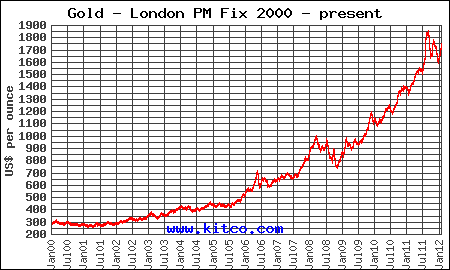
Fast forward to 2000, stock markets are spiking to all time highs.  However earnings for many companies are questionable.  Price-to-earning ratios are astronomical even for companies that earned money.  Bonds earned a decent return around 6%.  

Now if you were invested in stocks, where do you store hard earned gains if it appears everything is going to fall?  Remember in a stock rout, everything gets sold even good companies.  The reason behind this phenomenon is leveraged investors (e.g. investors who borrowed money to buy stocks).  As the amount of collateral in their account retreats, these investors get a margin call.  At that moment they either need to add more cash/collateral, or sell what they can to meet the requirements.  Hence good companies get sold because the bad companies are not worth enough to cover the margin call.  Therefore, all stocks fall.

So bonds are one option for hard earned gains because if the Fed lowers interest rates, the prices of your bonds would rise and you could profit from that rise.  Also, you buy stuff that everyone needs - energy, commodities, and gold.

Source: Kitco.com

Response and Affect

Instead of dealing with the economic imbalances created, the Fed did lower rates after the market crash of 2000 and kept them low for many years.  Whenever the Fed loosens monetary policy, the new money that floods into the system needs to find a "home." Coincidentally, homes were exactly where the money went.

Low interest rates spurred a housing boom.  Home ownership became more affordable. Combined with new financial "products," more people were able to acquire a mortgage than ever before.  This led to a construction boom and rising home prices.

Additionally, current homeowners could refinance into a cheaper interest rate.  Again combined with rising home prices, many of these owners went on spending sprees.

As the economy looked like it was better, the Fed raised interest rates.  Unfortunately few thought about whether the newly issued debt was going to be paid back.

A New Crisis

Summarizing the last few years, debts could not be repaid.  Home values crashed in places where prices had sky rocketed.  Stocks plummeted over 50% though now are back to within 15% of their all time highs.  Bond yields are near all time lows with the 10 year Treasury hovering around 2%.  Gold is down ~10% from its all time high, but up over 500% since 2000. While that is a nice gain, here are the reasons why I still like gold:
  1. Savings accounts have no return at best, negative return if you include inflation.
  2. Bonds have the same problems as savings accounts.  Furthermore bonds are vulnerable to a rise in interest rates, which will cause bond prices to fall - leading to a probable loss if you sell.
  3. Central banks continue an activist policy of trying to relieve financial stress by adding liquidity. As noted in Stay True to the Path or Take the Fork in the Roadthese policies do not solve the problem of too much debt.
  4. High debt - until the growth of debt around the world is brought under control, we will continue to have slow growth at best.  Without even thinking recession, a no growth scenario could cause stock prices to roll over.
  5. Insurance against Congress doing something really stupid.
So by diversifying into gold, I hedge losses in my savings accounts and bonds.  I also take advantage of all gains caused by central bank action.  Finally while I wouldn't bet on Congress doing something stupid, stranger things have happened.  Gold provides some insurance that some wealth survives any Congressional storm.

Ironically, I'm not the only one who likes to own gold.  According to the Wall Street Journal, central banks began buying gold again. Regardless of what you read/hear, gold is money.  (hat tip: Big Picture Blog)

Source: Wall Street Journal

Wrapping Up

There are a number of methods to get exposure to gold in your portfolio.  I list some of these methods plus some of their advantages and disadvantages.  Please consult your financial advisor to discuss which choice(s) might be right for you.

 Table 1: Methods to Buying Gold
Solution How Advantages/Disadvantages
Buy Gold through an investment firm that deals in gold coins or bullion. Pro: you have physical possession.
Con: you have to safely store it.
Gold ETF through your brokerage account. Pro: you have claim to gold in a safe location.
Con: you may not be able to physically retrieve your gold. Also you have to pay a management fee.
Gold Mining Stocks buy individual stocks through your brokerage account.   Pro: fixed costs means any rise in gold price is profit.
Con: mining is risky, gold may not be found. Potential for currency risk if not a US company. Stock price likely to drop in a crash (though it's likely it rebounds well too).
Gold Mining ETF or Mutual Fund buy an ETF or mutual fund through your brokerage account. Pro: owning many companies is less risky.
Con: fund expenses may be high.  Potential currency risk.

For the record: I own shares of a gold ETF and gold mutual fund.  I may buy more or sell these investments at any time without warning.  


Disclaimer: Please remember that I’m just a guy sharing information on a blog, and this is NOT official investment advice. Any action that you take as a result of information, analysis, or advertisement on this site is ultimately your responsibility. Please consult your investment adviser before making any investment decisions. During your conversation with said investment adviser, ask why they believe in their recommendation. If you are not convinced by their explanation, any action that you take or forego is also your responsibility. Just in case you missed that, you are responsible for your investments.

With that said, don’t let your investments keep you up at night. If they do keep you awake, you may be taking more risks than you are comfortable with. Talk to a professional about reallocating to less risky investments so that you can sleep. During your conversation with said professional, ask why they believe that their recommendation is less risky. If you are not convinced by their explanation, don’t invest. Remember:
  1. It’s your nest egg.
  2. Opportunities are easier to make up than losses.

Friday, February 10, 2012

James Bond Isn't the Only Dangerous Bond

What are the three terrors of the Fire Swamp? 
One, the flame spurt - no problem. There's a popping sound preceding each; we can avoid that. 
Two, the lightning sand, which you were clever enough to discover what that looks like, so in the future we can avoid that too. 
Westley, what about the R.O.U.S.'s? 
Rodents Of Unusual Size? I don't think they exist. - Princess Bride

The best (though sometimes the worst) thing about having a blog is that you can quote whatever you like.  So why can it also be the worst thing?  Late at night when your brain shuts down, you struggle to find any quote close to resembling your article.

Tuning out the GIPSIs tonight (Greece, Ireland, Portugal, Italy, & Spain), I wanted to draw your attention to Oracle of Omaha's wisdom as reported by Bloomberg Buffett: Bonds Are Among Most Dangerous Assets
Warren Buffett, the billionaire chairman of Berkshire Hathaway Inc., said low interest rates and inflation should dissuade investors from buying bonds and other holdings tied to currencies.

“They are among the most dangerous of assets,” Buffett said in an adaptation of his annual letter to shareholders that appeared today on Fortune magazine’s website. “Over the past century these instruments have destroyed the purchasing power of investors in many countries, even as these holders continued to receive timely payments of interest and principal.”

Buffett, 81, who built Omaha, Nebraska-based Berkshire from a failing textile maker into a firm selling insurance, energy and jewelry through acquisitions and stock picks, echoed Laurence D. Fink, chief executive officer of BlackRock Inc. Fink said this week that investors should be 100 percent in equities, because of depressed stock valuations and the Federal Reserve’s pledge to keep interest rates low.

“High interest rates, of course, can compensate purchasers for the inflation risk they face with currency-based investments -- and indeed, rates in the early 1980s did that job nicely,” Buffett wrote. “Current rates, however, do not come close to offsetting the purchasing-power risk that investors assume. Right now bonds should come with a warning label.”

The Fed has kept borrowing costs near zero, and said last month that economic conditions may warrant “exceptionally low levels” for rates through at least late 2014 to boost the economy and put more Americans back to work. Buffett said other currency-based investments that may pose a risk include money- market funds, mortgages and bank deposits.
Saying anything remotely opposite of Warren Buffett is like trying to cross a busy street during rush hour, you know you shouldn't do it because there's a good chance of getting hit. So let's talk about what I agree with in this quote - low interest rates and inflation should dissuade investors from buying bonds.

Looking at the following graph, we see the interest paid out by a 10 year treasury bond.  For a minute, let's ignore inflation and issuance of further government debt.  Let me ask you, what do you think the odds are that the rates get any lower versus the rates going higher?


It's fair to ask though why do higher rates matter to me?  If you own bonds or a bond mutual fund, they matter.  Let's walk through an extremely simple example where the numbers are for illustration purposes (e.g. I haven't calculated anything):

  • A few years ago, I buy a 10 year bond that pays 5% interest for $100.  Two years later recession hits and interest rates go down.  Looking for a good rate, you offer me $110 for my 5% bond.  Realizing a 10% gain, I sell you the bond which pays you less than 5% because you paid $110 for it, not $100.  For simplicity sake, let's say it pays you 3%.
  • 2 years later the economy recovers, but is now doing so well that new 10 year bonds pay 6% interest.  You have a choice, you can either hold the bond for 6 more years to get the $100 or you could sell it to someone else who may only pay you $90 for it. 

The lesson from this example is that investors that are buying newly issued debt, especially intermediate and long term debt, are like a moth near a bug light.  The moth thinks the light is safe, but it can easily get zapped.

So Where Might I Disagree with the Almighty Oracle

Rush hour must be ending because later in the article from Bloomberg:
Buffett said investors should avoid gold, because its uses are limited and it doesn’t have the potential of farmland or companies to produce new wealth. Achieving a long-term gain on the metal requires an “expanding pool of buyers” who believe the group will increase further, he said.
“What motivates most gold purchasers is their belief that the ranks of the fearful will grow,” he wrote. “During the past decade that belief has proved correct. Beyond that, the rising price has on its own generated additional buying enthusiasm, attracting purchasers who see the rise as validating an investment thesis. As ‘bandwagon’ investors join any party, they create their own truth -- for a while.”
Gold prices have climbed to more than $1,700 an ounce from less than $300 in the last decade, as investors sought safety in bullion.
Hypothetical question: when is insurance cheap versus when is insurance expensive?  Insurance is cheap when there is little risk of collecting and expensive when there is a higher chance the insurer will have to pay a claim.  Gold is expensive, but there's a good reason - gold is an insurance policy.  Gold buyers are insuring that their wealth against low interest rates and the printing of money, these days known Quantitative Easing.

Interest Rates Pay Little for Much of This Period

Global Central Banks Expand Their Balance Sheets Double or More
From The Big Picture blog

Investors Seek Safety for Their Wealth
Note that the Federal Reserve has increased the its balance sheet from less than $1 Trillion to almost $3 Trillion.  The central banks in China and Europe had much larger increases.  Plus as we have already established, interest rates pay nothing.

So How Does this Affect Me

There are a variety of factors that affect bond rates.  Currently the slow economy plus the flight to safety out of Europe is keeping US bond rates low.  However, the day is coming when bond rates will turn.  While you may have seen previous posts where I state I own bond funds, those holdings are subject to change at any time and without prior warning.  I am looking to diversify out of intermediate and longer term bonds.

Regarding gold, I'm not sure when its price stops going up.  In fact, it may have already stopped.  However with the EU crisis still unresolved, talk of €1 Trillion more in ECB lending at the end of the month, increasing US debt levels, and talk of more quantitative easing from the Fed, I think the price can go higher.

There are many ways to "own" gold.  The reason I have quotation marks around own is that if you look around the Internet, you'll find quite a few differing opinions on what owning gold means.  Skipping that conversation, here are a few options that you can explore: buy physical gold (though let me warn you that might make you a terrorist), buy gold through an ETF fund, or buy gold mining equities, mutual funds, or ETFs.


Disclaimer: Please remember that I’m just a guy sharing information on a blog, and this is NOT official investment advice. Any action that you take as a result of information, analysis, or advertisement on this site is ultimately your responsibility. Please consult your investment adviser before making any investment decisions. During your conversation with said investment adviser, ask why they believe in their recommendation. If you are not convinced by their explanation, any action that you take or forego is also your responsibility. Just in case you missed that, you are responsible for your investments.